
A feature story, op-ed, and community advocacy package on the global coding education crisis — and how CodeCircle.org is building a free, AI-powered answer, one child at a time.
In This Article
The Coding Gap: Why Millions of Children Are Being Left Out of Tomorrow
Available for attribution to CodeCircle.org. May be adapted for editorial use.
Imagine growing up in a world where every career of consequence — medicine, law, engineering, finance — required literacy, but your school had no books. That is the reality for millions of children today, except the literacy in question is not reading: it is coding.
This is the digital divide. It is not a metaphor. It is a measurable, documented, and growing gap between children who learn the language of technology early — and those who are handed the future's most important skill set only after the door has already begun to close.
The Scale of the Problem
In the United States alone, the Bureau of Labor Statistics projects that computing occupations will grow by more than 15% through 2031 — adding hundreds of thousands of jobs. Yet the pipeline of students — particularly from low-income, rural, or underrepresented communities — remains dangerously thin. A 2023 report by Code.org found that only 57% of U.S. high schools offer foundational computer science classes. For schools in low-income districts, that number drops even further.
Globally, the picture is starker. In developing regions across South Asia, Sub-Saharan Africa, and Latin America, access to coding education is effectively non-existent for the majority of children. The instructors are not there. The devices are scarce. And the courses that do exist — from private coding bootcamps to university programs — cost more than most families in those regions earn in months.
The consequence is not just economic. It is a narrowing of who gets to shape the future. Technology is not a neutral force: it reflects the values, blind spots, and imaginations of the people who build it. When those builders come from a single demographic slice — affluent, urban, largely Western — the technologies they build serve those same communities first.
The Opportunity Gap in Numbers
- Only 57% of U.S. high schools offer foundational computer science — lower in low-income districts
- Computing occupations projected to grow 15%+ through 2031 (U.S. Bureau of Labor Statistics)
- Private coding bootcamps charge $10,000–$20,000+ for skills CodeCircle.org provides free
- Millions of children in developing regions have zero access to any structured coding education
- Girls, children of color, and rural students are disproportionately excluded from existing programs
A Nonprofit Born From the Same Gap
Satya Dillikar knows this gap intimately. He did not read about it in a policy report — he lived it. Growing up in India in the 1990s, he passed by technology institutes he could not afford every single day on his commute to school. He eventually negotiated his way into a computer lab — not as a student, but as a helper — earning 30 to 45 minutes of computer time per day in exchange for administrative labor.
“I remember what it felt like to look at something I desperately wanted to learn and know that it was just out of reach. I am building CodeCircle.org so no child ever has to feel that.”
That center became VGURU Learning Center, then VGURU Tech Academy, and in 2025 launched publicly as CodeCircle.org — a full Learning Management System, available online, globally, entirely free, powered by artificial intelligence.
The AI Difference
What sets CodeCircle.org apart is its strategic use of AI as a structural solution to the scarcest resource in education: qualified instructors. CourseCraftor AI enables any educator to generate a full, structured coding course from a single prompt. TutorBot AI gives every enrolled student a 24/7 personal tutor that explains concepts rather than just providing answers.
What $0 Buys at CodeCircle.org
- Full access to structured coding courses (Python, AI, Data Science, Web Development)
- 24/7 TutorBot AI — personal coding tutor that adapts to each student's pace
- CourseCraftor AI for instructors — build a complete course from one prompt
- Progress tracking, lesson plans, and classroom management tools
- Community of learners, mentors, and mission-aligned educators
The platform is free. The mission is urgent. And the question this article leaves with every reader is the same question Satya asked himself when he decided to start: if not us, who? If not now, when?
We Cannot Afford to Leave Another Generation Out of the Code
When I was sixteen years old, I used to stand outside computer institutes in India and read the course listings the way some kids read restaurant menus — hungrily, knowing they couldn't order anything. Programming classes cost money my family didn't have. The future being advertised on those billboards was not being advertised to me.
I eventually found a way in — an overnight deal with a lab owner, some bananas for dinner, and a copy of a Pascal manual. It worked. I went on to earn a gold medal in Computer Science, a Master's from IIT Madras, and a career in technology. But I have thought about those billboards my entire adult life. Not with bitterness — with resolve.
Because the children standing outside those metaphorical institutes today are not in India in 1991. They are in Fresno, California. They are in rural Mississippi. They are in Lagos and Nairobi and Bogotá. And the institute they cannot afford is not a programming class in a local building — it is the entire edifice of modern technology education, priced and positioned for families who already have advantages.
“The question is not whether AI will transform every industry. It will. The question is whether the children being raised right now will be able to participate in that transformation — or simply be subject to it.”
I started CodeCircle.org because I believe access to coding education is a civil issue, not a commercial one. When we treat it as a product — something to be priced, licensed, and tiered — we make a choice about who the future belongs to. I refuse to accept that choice.
Our platform is free. Completely, structurally, permanently free — for every student, in every zip code, on every device. We use AI not because it is fashionable but because it is the only way to deliver the kind of personalized, patient, always-available instruction that wealthy families buy with private tutors and premium programs. AI lets us scale the thing that has always been most scarce: a great teacher who has time for your child specifically.
The results are already being written by our students. A fourth-grader building a Python calculator app. A seventh-grader winning a hackathon with a weather prediction model. A tenth-grader whose AI chatbot for teen mental health won a youth innovation challenge and earned her a summer internship. An undergraduate developing crop disease detection software now used by an agricultural nonprofit.
These are not exceptional children. They are children who were given access. There is a difference, and it matters enormously.
What I am asking — of readers, of educators, of corporate leaders, of policymakers — is to treat this issue with the seriousness it deserves. Not as charity. Not as a feel-good initiative. As infrastructure. Coding literacy is as foundational to the 21st century as reading literacy was to the 20th. We built public libraries. We passed compulsory education laws. We funded school systems. We did those things because we understood that a society's potential is limited by the opportunities it makes available to all of its children — not just the ones born to the right families.
Because the children who are growing up right now without the chance to learn coding — they are not waiting for us to figure this out. They are just missing out. And every year we wait is another year we cannot get back.
Satya Dillikar
Satya Dillikar is the Founder and Director of CodeCircle.org, operated by VGURU Foundation (EIN: 33-3624722), a 501(c)(3) nonprofit based in California. He holds a Bachelor's in Computer Science and Engineering (Gold Medalist) and a Master's in Computer Science and Engineering from IIT Madras. He can be reached at [email protected].
Why the Coding Gap Is a Crisis
The People Behind the Mission
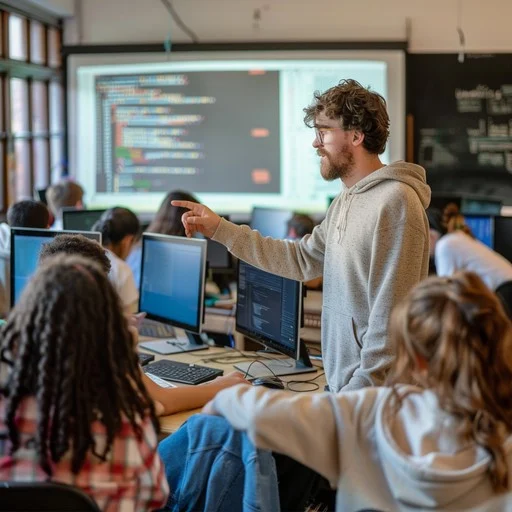
CodeCircle.org's impact is not limited to students. A passionate team of interns and volunteers — many of them young professionals — is building the platform from the inside, gaining real-world experience while advancing a mission they believe in.
“Being a Curriculum Developer Intern has been one of the most rewarding parts of my journey. I loved turning complex tech topics into fun, bite-sized lessons kids can actually enjoy. It's amazing to know the resources I've built are helping students across the country gain confidence in Maths, Python, and AI. This role truly let me combine creativity with impact.”
“As a Product Manager Intern, I gained invaluable experience with real PM frameworks like PMF and SWOT. The global exposure, working on an AI-first LMS, and the mentorship from founders were incredible. It's truly inspiring to contribute to a mission-driven team that's scaling free coding education globally.”
“I joined to help spread the word about coding, but what I found was a deeply connected and passionate community. Through school visits, parent sessions, and local events, I've seen firsthand how access to learning changes lives. Being part of that transformation is incredibly fulfilling, and I've built real-world outreach and marketing skills.”
Talking Points for Community Leaders & School Boards
For community advocates, board members, and policymakers championing coding access in their district, city, or state.
Coding literacy is foundational infrastructure, not optional enrichment.
Just as we fund reading instruction and libraries, we must treat coding literacy as a public good. The jobs of the next generation require it. The tools to deliver it now exist — and are free.
The digital divide is a local issue, even when it looks global.
Whether in rural California, urban Los Angeles, or the Central Valley, students in low-income districts are less likely to have access to quality coding instruction. CodeCircle.org is designed to be deployed at the district level with zero cost barrier.
AI in education can be equitable — if we choose to make it so.
TutorBot AI demonstrates that AI can function as a democratizing force — giving every child access to the personalized instruction that used to be available only to those who could afford a private tutor.
Free does not mean low quality.
CodeCircle.org's curriculum is educator-designed, AI-enhanced, and producing students who win hackathons, earn internships, and build tools that serve their communities.
Partnerships amplify impact with no budget required.
A district that integrates CodeCircle.org into after-school or elective programming does not need to fund instructors, purchase licenses, or build curriculum. The platform handles all three. The district contributes: awareness, devices, and intent.
“Talent is everywhere. Opportunity shouldn't be rare.”
Every Action Matters. Here Is How to Take One.
Join thousands of students, educators, and advocates building a world where every child has access to the skills that will define the future.
Students & Educators
Sign up for free at codecircle.org and start learning or teaching today. No cost, no prerequisites, no waitlist.
Advocates & Partners
Share this page, post the social copy above, and send the newsletter template to your community. Awareness is impact.
Donors & Foundations
Donate at codecircle.org or contact [email protected] to discuss grants, sponsorships, and district partnerships.

Ready-to-Share Posts for Advocates & Partners
Pre-approved post copy for educators, community partners, and media outlets. Adapt as needed. Tag @CodeCircleOrg and use #FreeToLearn #CodeCircle #CodingForAll.